
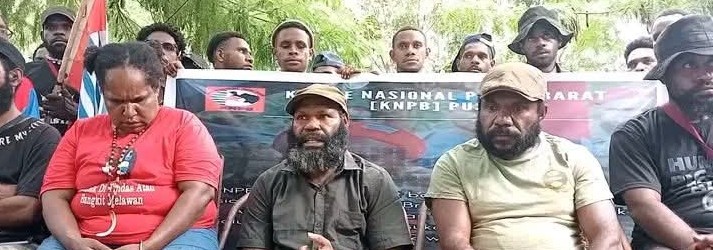

JAYAPURA — The West Papua National Committee (KNPB) called for an open consolidation to respond to the worsening humanitarian crisis and military escalation in Land of Papua throughout April to May 2026.
The KNPB Central Working Body assessed that the series of events in the last two months in the conflict areas has triggered gross human rights violations and international humanitarian law. The impacts of this situation include the loss of civilian lives, mass displacement, arbitrary arrests, intimidation of activists, to the seizure of customary land.
The escalation of armed violence was reported spreading in a number of strategic points in the highlands and coastal areas of Papua. Military operations and aerial bombings in Puncak Regency from April 14 to May 5, 2026 became the main trigger for a massive wave of displacement and the loss of civilian lives. A shooting incident also targeted a student in Kobakma, Central Mamberamo Regency on May 5, 2026, as well as a Civil Servant (ASN) in the conflict area.
Marine personnel and the Indonesian military were reported continuing to carry out arbitrary arrests against civilians in the red zones. In Yahukimo, successive arrests against humanitarian activists occurred on April 21 to 25 as well as May 10 and 19, 2026. Meanwhile, the 1711 Military District Command (Kodim) arrested four humanitarian activists in Boven Digoel Regency on May 1, 2026.
An offensive operation in Kali Kabur, Tembagapura, Timika on May 7 to 8, 2026 also added to the long list of injured and deceased victims from the civilian group. The shooting of local residents was recorded in Dogiyai on May 10, 2026, which was followed by a large-scale troop mobilization as well as shootings in Nabire on May 12 to 22, 2026. This armed conflict even damaged religious facilities due to a bomb attack at the St. Paul Nabuni Catholic Church, Mbamogo, Bilogai Parish, Intan Jaya Regency on May 17, 2026.
The bomb explosion in the church complex injured at least four civilians and worsened the psychological trauma of the community in the central highlands region. Non-physical structural conflict also occurred through the seizure of customary land belonging to the Kamuyen Clan in Nakias, Merauke on May 23, 2026. This series of security operations has direct implications on a drastic surge in the number of internally displaced persons (IDPs) in the interior of Papua.
The latest data from the independent monitoring agency Human Rights Monitor shows the number of refugees due to the conflict in Papua up to March 2026 reached 107,039 people. This number swelled after the addition of 22,661 residents who fled from Puncak Regency post-operation last April, so that the total number of refugees is now estimated to surpass 129,700 people.
The KNPB asserted that armed warfare methods, domestic area bombings, and the criminalization of human rights defenders violate national and international law.
The militaristic policy is assessed to contradict Law Number 39 of 1999 on Human Rights and Law Number 26 of 2000 on Human Rights Courts. Security actions on the ground are also assessed to violate the 1849 Geneva Convention and the principles of International Humanitarian Law (IHL), specifically regarding the principle of distinction of combatants and the protection of civilian areas. Other international regulations violated include the Universal Declaration of Human Rights, the International Covenant on Civil and Political Rights (ICCPR) Law Number 12 of 2005, and the Convention Against Torture (CAT) Law Number 5 of 1998.
The KNPB expressed appreciation for the release of the documentary film Pesta Babi by directors Dandhy Laksono and Cipri Dale, and producer Victor Mambor. Publications from media such as Jubi, Pusaka Bentala Rakyat, Greenpeace, and Watchdoc are assessed as successful in showing the real facts of structural oppression, marginalization, and exploitation of Papua's nature to the global community.
"We strongly condemn the military approach carried out in civilian areas in Land of Papua, especially military operations that directly impact civilians in Puncak, Intan Jaya, Tembagapura, Yahukimo, and other conflict areas," said the KNPB Spokesperson, Saturday (5/30/2026).
The Indonesian government is urged to open full access for foreign journalists, humanitarian agencies, and United Nations (UN) special rapporteurs to conduct independent investigations in Papua. The state is requested to immediately stop intimidation tactics, abductions, torture, and the use of aerial explosives in civilian residential areas. All forms of legal criminalization against political activists, students, journalists, and human rights defenders throughout the Papua region must be stopped without condition.
The KNPB also invites all civilian elements in Papua and Indonesia to strengthen humanitarian solidarity and build peaceful consolidation. Religious institutions, domestic NGOs, and the international community are expected to expand the distribution of logistical assistance and legal protection for internally displaced persons. Long-term solutions must be pursued by encouraging a ceasefire between the National Liberation Army of West Papua (TPNPB) and the Indonesian National Armed Forces-National Police of the Republic of Indonesia (TNI-Polri).
An inclusive and fair political dialog needs to be immediately mediated by a neutral international third party to resolve the root of the conflict. The fundamental rights of indigenous peoples over ownership of land, territory, and natural resources must be protected from corporate and military expansion. The KNPB also requests the UN Human Rights Council to give special attention to the ongoing humanitarian crisis in this region.
The political stance to demand the right to self-determination through an international referendum mechanism that is democratic and peaceful remains the main resolution of the KNPB. The TPNPB also continues to maintain their defense command positions in various customary territories to balance the tactical movements of the Indonesian military. The mobilization of international support continues to be accelerated to end information isolation and violence that threatens the existence of indigenous Papuans. (One Papua)