
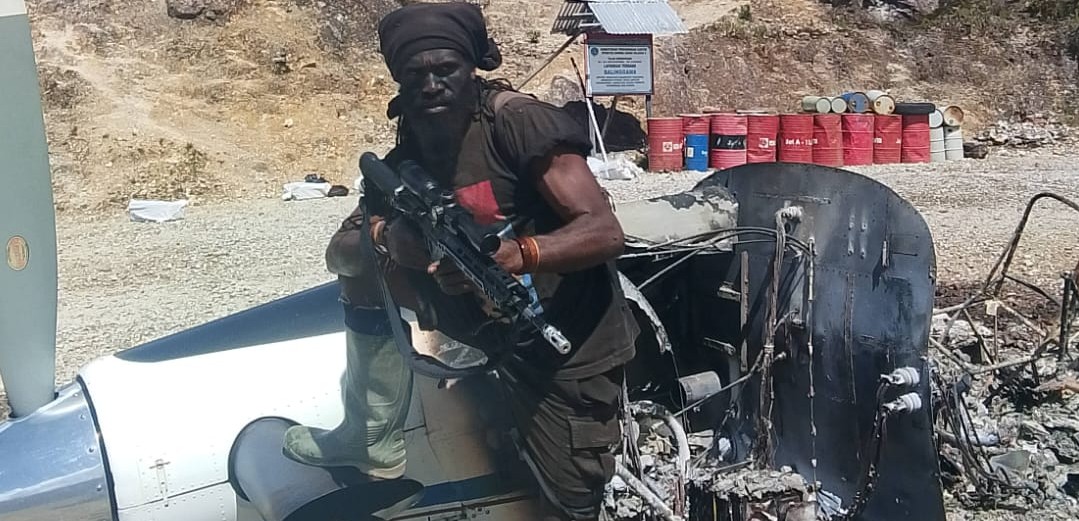

PAPUA — The narrative surrounding the role of commercial aviation in Papua’s highlands has ignited intense debate. Amidst escalating tensions between the West Papua National Liberation Army (TPNPB) and security forces, Buchtar Tabuni, Chairman of the West Papua Council, has leveled sharp criticism at attempts to frame airlines—specifically Associated Mission Aviation (AMA)—solely as humanitarian entities serving the region’s remote communities.
In a written statement, Tabuni rejected what he termed a "misleading" narrative, emphasizing that AMA, which has operated in Papua for nearly seven decades, is essentially a business enterprise.
"It is inaccurate to claim that AMA commercial aircraft are solely serving remote Papuan communities," Tabuni stated. "It is more accurate to say that AMA has been conducting business in Papua for approximately 67 years by providing transport services for which users pay."
Tabuni underscored the importance of clarifying the term "service," which he argues has been used to legitimize the position of aviation companies within the conflict zone. According to him, the relationship between AMA and the local population is purely transactional.
"The public pays for the transport services they use," he asserted. "This is not a service provided for free or through missionary subsidies."
He added that the use of the term "serving the community" without acknowledging its commercial nature risks obscuring realities on the ground. For Tabuni, precision in language is crucial for the public to understand the nature of the relationship between companies and their clients, free from what he describes as "manipulated humanitarian sentiment."
Furthermore, Tabuni warned against using differing interpretations of the aviation industry's role to simplify the broader, complex political dynamics in Papua. He highlighted a trend where certain parties consistently blame the TPNPB whenever incidents involving aircraft occur.
He maintained that blaming the TPNPB without grasping the context of the independence struggle and the root political issues is a fundamental error.
"The issue in Papua is a matter of political rights and self-determination," Tabuni said. "Do not use aviation issues to reduce this conflict or to continuously blame the independence fighters."
This statement comes at a time when the security situation in Papua’s highlands remains volatile. For the TPNPB, the presence of air transport operating in conflict-ridden areas is often viewed through the lens of security surveillance, whereas for corporate and government stakeholders, these operations are considered the logistical backbone for geographically isolated communities. (One Papua)