
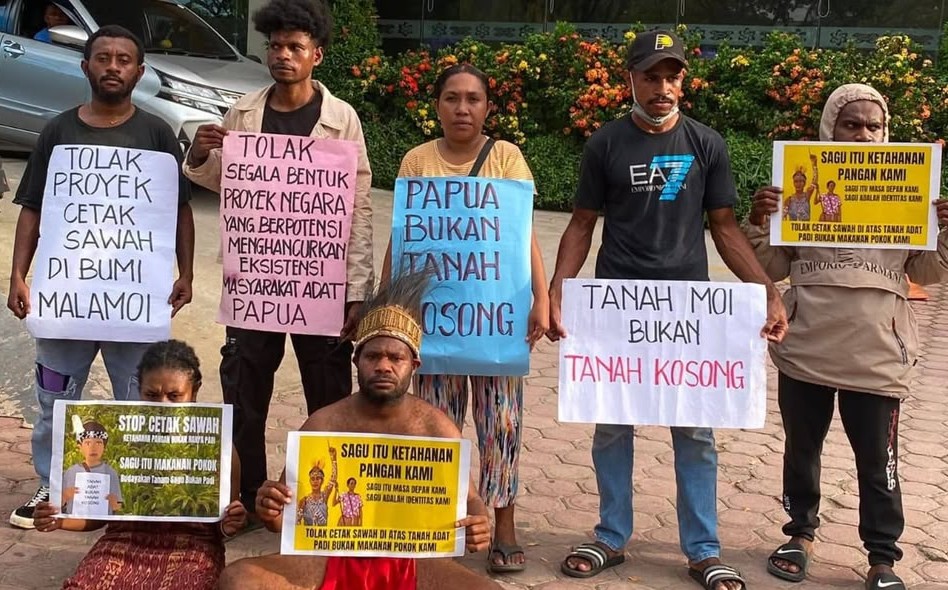

SORONG - A community group calling themselves the Malamoi Indigenous Youth held an open protest rejecting the socialization agenda for the implementation of the national rice field printing program. The rejection of this 2026 fiscal year program was carried out in the midst of an ongoing government coordination meeting at the Prime Vega Hotel, Sorong City.
The coordination agenda was organized by the Ministry of Agriculture of the Republic of Indonesia along with the Directorate General of Agricultural Land and Irrigation and the Class I Agricultural Irrigation Land Management Balai of Jayapura.
Demonstrators assess that the implementation of the agrarian project has the potential to ignore the rights over communal land ownership belonging to the indigenous people.
The scope of this rice field printing project is planned to target a number of forest areas and productive areas in Sorong Regency and South Sorong Regency. Meanwhile, the wave of rejection from the indigenous youth is based on concerns over the loss of indigenous management areas due to large-scale land function conversion.
The rejection action emphasizes the importance of full involvement of local communities before strategic decisions regarding the utilization of living space are made by the ministry.
"We reject this rice field printing socialization because it was carried out without the basic consent of the Malamoi communal land rights owners," said a representative of the Malamoi Indigenous Youth, Tuesday (2/6/2026).
The firm stance from the indigenous youth received direct attention from the West Papua National Liberation Army-Free Papua Organization or TPNPB-OPM operating in the Sorong Raya region.
TPNPB declared full support for the steps of the indigenous youth in defending communal land rights from the intervention of the national food security program.
The involvement of security forces in escorting the ministry's team in the field is also said to trigger an escalation of concern among civil society.
TPNPB criticized the deployment of Indonesian National Armed Forces personnel accompanying ministry officials because it was assessed as a form of psychological pressure against the landowners.
The presence of the Indonesian military in the agricultural land expansion program is assessed not to be focused on economic empowerment but rather to secure the flow of foreign investment.
TPNPB even requested all technical agencies and government corporate partners to immediately stop land mapping activities in the indigenous area.
The Indigenous Youth declared readiness to expand the scope of mass action if the aspirations conveyed are not accommodated. (One Papua)