
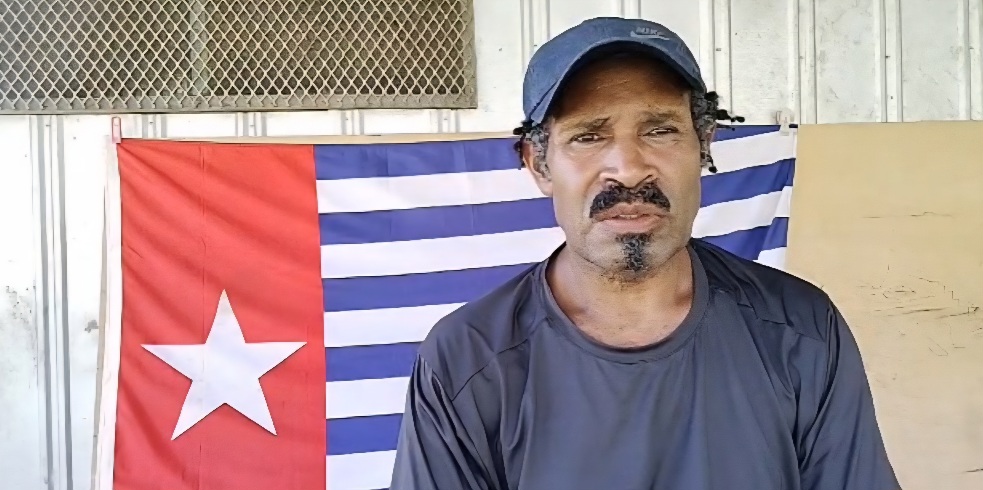

PAPUA — The Headquarters Management of the West Papua National Liberation Army (TPNPB) issued a warning and strict appeal to all parties, especially the indigenous Papuans who reside in the customary territories of Mepago and Lapago.
The National Command Spokesperson of the Headquarters Management of TPNPB, Sebby Sambom, emphasized that the tribal war that always occurs in Wamena and the Mepago region, especially in Puncak Jaya, Puncak Papua, Intan Jaya, and the Lapago region such as Wamena, Nduga, and Lanny Jaya does not benefit oneself, every tribe, or the Papuan nation at all.
TPNPB warned to end the conflict because that action only destroys Papuan civilization.
In collective memory, TPNPB has a reference text customarily, especially for people in the Lapago region based on the customary order and philosophy that mentions the names of the tribes from generation to generation with designations that are never inverted. Over there, there are the Jali, Hubula, Lanny, Wendasi, Nduga, Loma, Damal, Isani, Moni, and Ekari tribes. Through this customary structure, TPNPB emphasized that there was never a tribe named Walang in that order. On the contrary, the Wendasi and Kem or Bu Kem tribes are the first designations that exist in the customary order from generation to generation which has been kept neatly since God's creation 3,000 years ago without ever being violated.
Based on that customary basis, TPNPB conveyed a deep message to the Papuan youth to learn well, sit at home, and speak with parents so that the way of life, way of view, and emotional can be stable.
According to the history of ancestral stories, human civilization of the mountain people in Papua shows that there was never an enemy among the Jali, Hubula, Kem, Lanny, Nduga, Wendasi, Damal, Moni, and Ekari tribes. Tribal war historically never occurred among those tribes because of the existence of a strong bond of mutual interest.
History records that during the division of humans, they cut down the giant Jali wood in Kurima in Kalimbali, then everyone gathered in Kurima, which in the Damal language means the place where people gather. From Kurima they went out to Kurunauk, in the field in Mukoko, Kurama, and Baliem Valley, then gathered in Osiela or Osilimo which became the place for the division of humans. The Lanny tribe is a designation in the Hubula language, while the Jali people returned to the Jali region.
Through this history, the Jali people who passed through Kurima, Pugima, and Kurulu always visited Hulama to check on their families that they left behind in Hulama, where the Hubula people would open the way safely. The term 'Wala' itself is not a tribe, but rather a signature greeting used in peaceful interactions between those tribes.
This relationship was strengthened by traditional trade in the Baliem Valley, where the Lanny people brought white salt, the Jali people brought siwat or sago, and everything was exchanged for noken and big pigs.
Seeing that reality of the past, TPNPB questioned the basis of the tribal war occurring today and stated that the conflict has no basis at all.
TPNPB assessed the current action only creates new enmity and reflects a generation that is immoral, uncivilized, and uncustomary, which should not exist within the Papuan nation.
TPNPB obligates the elders of all tribes to teach your children to stop the war between tribes. Even though in the past there were internal conflicts within each of the tribes themselves—such as Jali with Jali after the Gospel entered around the 1960s, Hubula with Hubula, Wendasi with Wendasi, Lanny with Lanny, Nduga with Nduga, Damal with Damal, as well as Moni—yet there was never a history of another tribe fighting against a different tribe.
Based on the records of a German missionary in a book regarding tribal religion and the pig myth in the Jali tribe, the local community even already had an ancestral belief system to their ancestral God before the arrival of outside missionaries.
Therefore, TPNPB requested that all forms of this sentiment be stopped immediately because that situation is deliberately utilized by the Indonesian side, especially the military and police, to divide and annihilate the indigenous Papuans.
TPNPB appeals to all communities in the Lapago region, Mepago, to the Damal, Lanny, Moni, and Ekari communities in Timika to stop the war and unite to think about how to live prosperously, run humanitarian missions, and maintain peace for freedom like other nations in Melanesia that have independent and free from torture and murder.
"We think about fighting one only. Expel Indonesia from Baliem Valley. The key to that Baliem Valley is we expel Indonesia, meaning everything will run. Everyone unite and we fight and expel them from our ancestral land," emphasized Sebby Sambom. ***