
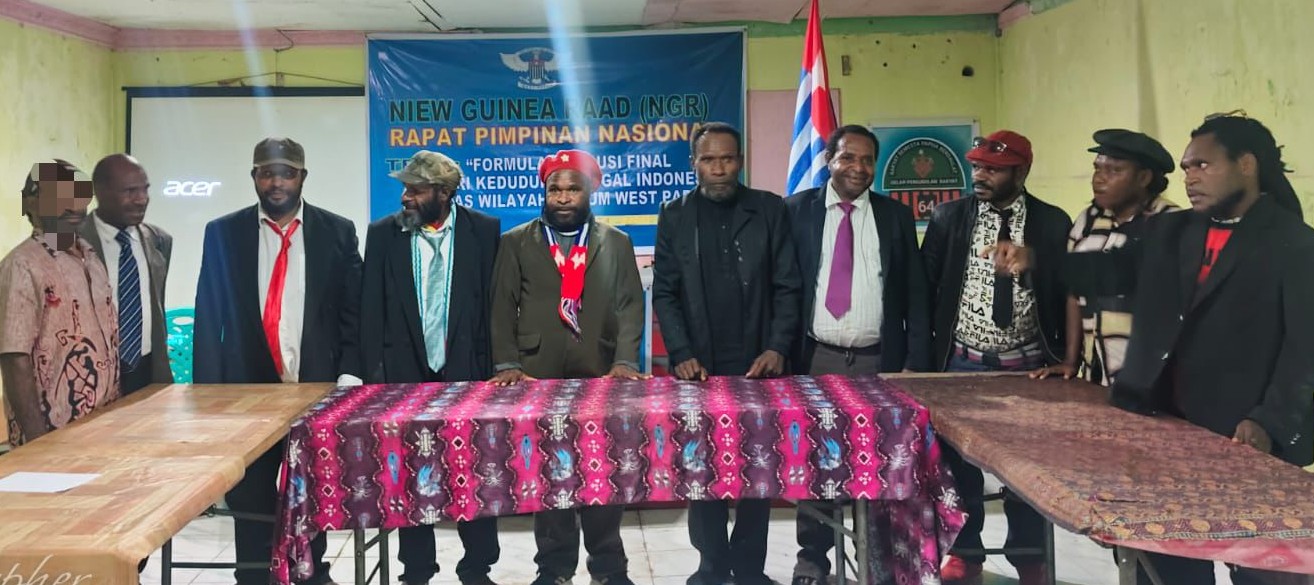

JAYAPURA - The West Papua legislative body, the New Guinea Council (Nieuw Guinea Raad - NGR), has called on the international community to give serious attention to the emergency situation in Papua. The NGR officially urged the United Nations Security Council (UN SC) to immediately intervene to end what is described as a humanitarian crisis and the illegal occupation by the Indonesian government.
This step was taken following the National Leadership Meeting (Rapat Pimpinan Nasional - Rapimnas) of the NGR held in Port Numbay.
“The Declaration of Independence of the Papuan Nation on December 1, 1961, is valid, final, and eternal under international law,” said the Chairman of the New Guinea Council, Aminius Balingga, Monday (25/5/2026).
The NGR asserted that the historical and constitutional legitimacy of the State of West Papua, which was declared on December 1, 1961, cannot be erased by any unilateral agreement. Based on historical records, the West New Guinea region was administered by the Netherlands as a separate entity and was never part of the territory proclaimed by the Republic of Indonesia on August 17, 1945.
The aspiration for independence is considered to have a solid foundation in international law that meets the principle of self-determination. This is also in line with the UN General Assembly Resolution 1514 (XV) on the granting of independence to colonial countries and peoples, as well as Resolution 1541 (XV). The massive presence of the Indonesian military in civilian settlements currently is assessed to further worsen the socio-political dynamics in the land of Papua.
Through the 1962 New York Agreement, the administration of West Papua was transferred to the United Nations Temporary Executive Authority (UNTEA) before finally being handed over to Indonesia on May 1, 1963. This unilateral transfer of power without involving the genuine representation of the Papuan people is viewed as violating the international law principle of pacta tertiis nec nocent nec prosunt. The peak of this historical issue occurred during the implementation of the Act of Free Choice (Penentuan Pendapat Rakyat - PEPERA) in 1969, which is judged to be fundamentally flawed.
The consultation process only involved 1,025 handpicked people out of a total population that reached more than 800,000 people at that time. The implementation of PEPERA 1969, which was carried out under military intimidation without adequate independent supervision, is also deemed to violate the provisions of UN Resolution 2504 (XXIV). Various reports from international human rights organizations such as Amnesty International and Human Rights Watch continue to highlight the systematic suffering experienced by the Papuan people.
A series of military violence events since 1963 is said to have resulted in the loss of hundreds of thousands of lives in this frequently ignored humanitarian tragedy. Apart from the loss of lives, security operations have also resulted in the forced displacement of indigenous communities in the Central Highlands, Meepago, and Lapago regions. The policy of restricting access for foreign journalists and international humanitarian agencies makes the West Papua region one of the most closed areas in the world.
The steadily worsening condition of the region prompted the NGR to provide full support for the decision of the National Committee for West Papua (Komite Nasional Papua Barat - KNPB) which declared the status of a Military and Humanitarian Emergency Zone. The use of warfare equipment, which is deemed excessive in civilian residential areas by the Indonesian military, must be stopped immediately for public safety. The armed resistance actions carried out by the National Command of the West Papua National Liberation Army (Tentara Pembebasan Nasional Papua Barat - TPNPB) are described as a law enforcement step to protect the sovereignty of the homeland.
The massive exploitation of natural resources, which takes place without the consent and fair benefit for the indigenous Papuan people, is also a major trigger for the escalation of the conflict. The NGR appealed to Papuan diplomats abroad to unite ranks and strengthen international diplomacy networks amidst this emergency situation. This political struggle is assured not to aim at creating regional security destabilization, but rather to seek a dignified solution.
The NGR also encouraged the formation of an international coalition involving the governments of countries such as Israel, Australia, Senegal, Ghana, and Timor-Leste to urge immediate action from the UN Security Council. Countries member to the Melanesian Spearhead Group (MSG), the Pacific Islands Forum (PIF), and the African Union are expected to be willing to co-sponsor an International Court of Justice (ICJ) resolution for the sake of justice. The TPNPB is also preparing to conduct a comprehensive internal consolidation to unify national struggle steps in facing this crucial situation. (One Papua)